
Introduction to ESOL for new migrants
An information resource all about immigration status and access to ESOL classes

If you’ve moved to the UK and want to learn English, WELCOME! On this page you fine out all about English classes and qualifications. We will help you find the right class for you, and all the things you need to know as you progress in your journey of learning English.
English classes for people who are settled or hoping to settle in the UK are called ESOL classes. ESOL stands for English for Speakers of Other Languages.
This guide will help you understand:
- What kind of ESOL classes you can join
- Whether the classes are free or paid
- Where to find support near you
There are different kinds of ESOL Class
Informal Conversation Classes
FREE for EVERYONE!
- Beginner levels to Entry 3 / Level 1.
- Charity-funded – GO TO AS MANY CLASSES AS YOU WANT!
- Continue with Informal Conversation Classes even if you have progressed to Community ESOL or Formal Courses.
Community ESOL Courses without exams
FREE for most people!
- Some centres may also help with costs such as travel.
- These run at different levels. The teacher will check if it is right for you.
- Run by charities, community organisations and some colleges.
- Some are funded by the government or local authorities. Often, this means you can only do ONE of these courses.
Formal ESOL Courses that lead to exams
FREE for most people!
- You need to have no income or a low income (less than £25,750), or benefits, including NASS support for asylum seekers.
- Some colleges also help with costs if you have a low household income.
- Run by colleges and large learning centres.
- All have ASF funding so you must choose only ONE
- Different levels – beginners to advanced – so a teacher will check the course is the right level for you.
You can find any of these classes close to where you live using the search function on this website.
Some important words and rules about doing ESOL classes
- Classes are funded in different ways. Funding means where the money comes from to pay for the classes.
- Most informal conversation classes are funded by charities
- Many community classes are funded by charities, but some are funded by the government or local authority
- Most college and adult education classes are funded by the government using the Adult Skills Fund (ASF)
Adult Skills Fund (ASF)
- ASF classes are run at colleges, adult learning centres and some community organisations
- ASF classes are at different levels and often lead to qualifications
- ASF classes are open to most people but you must meet the funding rules. Follow the links below for more information on this.
Remember!
- You can only do one ASF course at a time.
- You can register for more than one, but if you are invited to join several classes you will need to choose only ONE.
What is ESOL?
You can watch this short video to find out more about ESOL classes in the UK. short video will help you understand:
Whether you’re an asylum seeker, refugee, a new migrant or BNO, this film will help you understand your options and get started with learning English. If some of the language is not familiar, scroll down to keywords for support with this.
This film was created for our sister site, Learning English in Yorkshire and Humber. To find out about classes in the East Midlands, go to Learning English in the East Midlands.
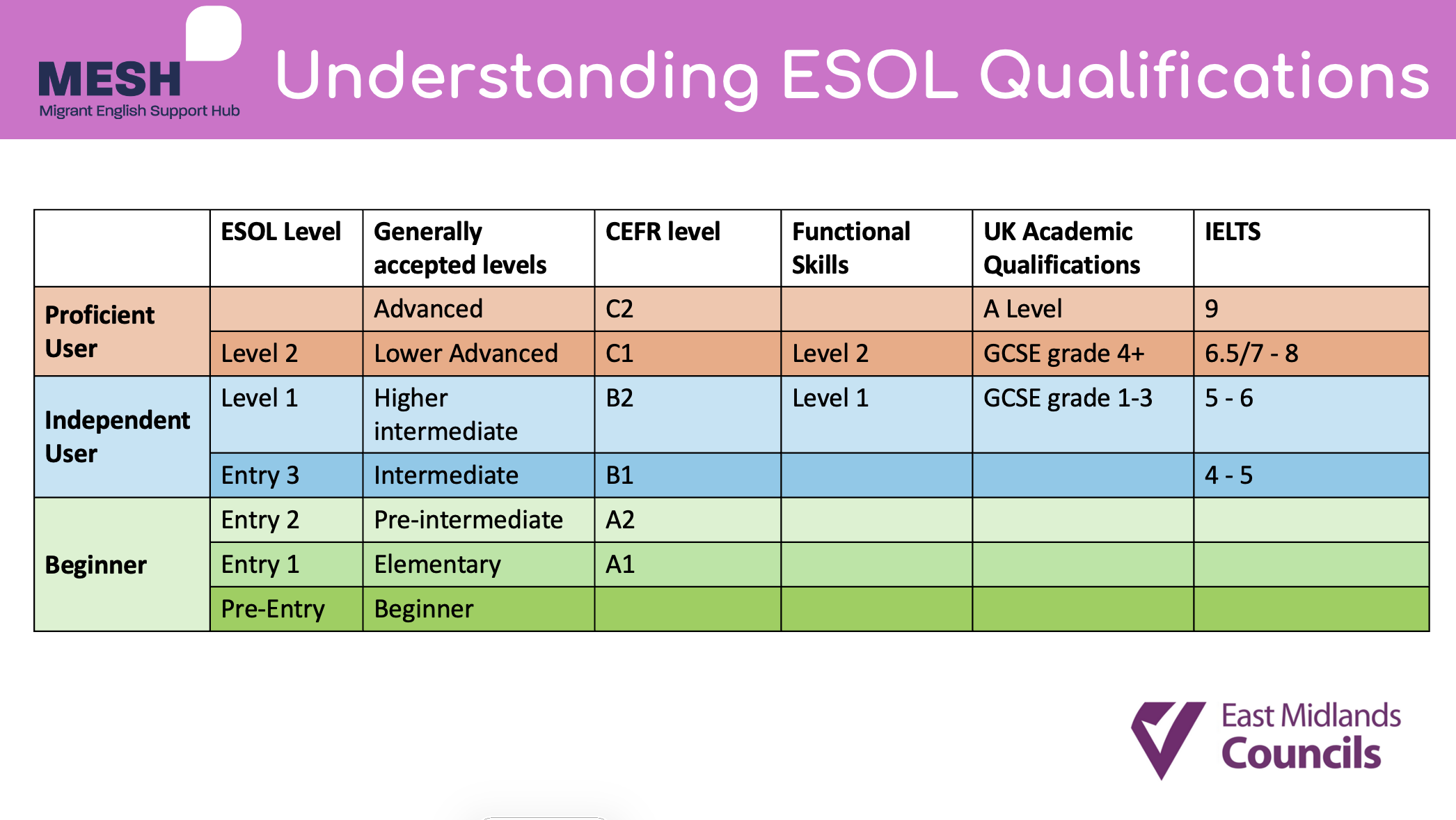
In the table, ESOL qualifications are measured against other ways of recognising progress in learning English.
- CEFR stands for Common European Framework of Reference for Languages.
- This is important as it is used by the government to assess English proficiency for citizenship applications. To obtain citizenship, applicants currently need to achieve B1 level English in a Secure English Language Test.
- The table also includes IELTS scores. IELTS stands for International English Language Testing System. You may need to take a test in this system if you want to go to university in the UK. See our Going to University resource for more details on this.
- The table also includes UK Academic Qualifications.
- GCSE (General Certificate of Secondary Education) is a qualification often taken at school. It is the most widely recognized standard of English learning.
- Adults can also take a GCSE. It is not designed for second language speakers.
- The table also includes Functional Skills qualifications.
- These are not designed for second language speakers
- BUT many ESOL learners DO study Functional Skills at Level 1 & 2 because these are more widely available and they are generally free.
- It is NOT recommended to take Entry level (E1, E2, E3) classes in Functional Skills if you are a second language speaker, so these don’t appear on the table.
What classes can I take?
Answer the questions below and follow the links for more information
Are you seeking Asylum?
Find out what ESOL classes you can access while waiting for a decision on your asylum claim.
Are you a refugee or on a resettlement scheme?
Find out what free English classes are available if you have refugee status, on a resettlement scheme or you have leave to remain in the UK.
Do you have a BNO visa?
Explore your options for free or funded ESOL classes as a BN(O) visa holder from Hong Kong.
Do you have a work, student or family visa?
Find out what English learning options are available if you have a work, student, or family visa.
What is ESOL keywords
Here you will find some keywords used to talk about ESOL classes. All of the words listed here are used in the video at the top of this page. You can find the words listed with their meanings, plus an example sentence to show how they are used in talking and writing about ESOL. If you click on the audio links you can check your pronunciation if each keyword.


Some useful links
Secure English Language Test (SELT)
This is the Government website that explains the SELT test and where you can take it.
Going to University
Follow this link to to find out about how to apply to university, how to get funding support, and what English qualifications you need. This is a MESH resource.